


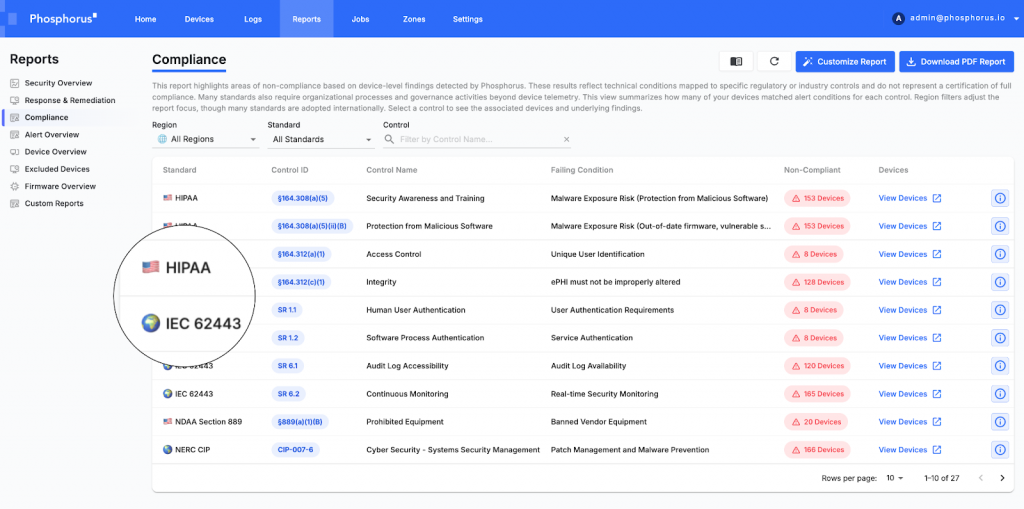
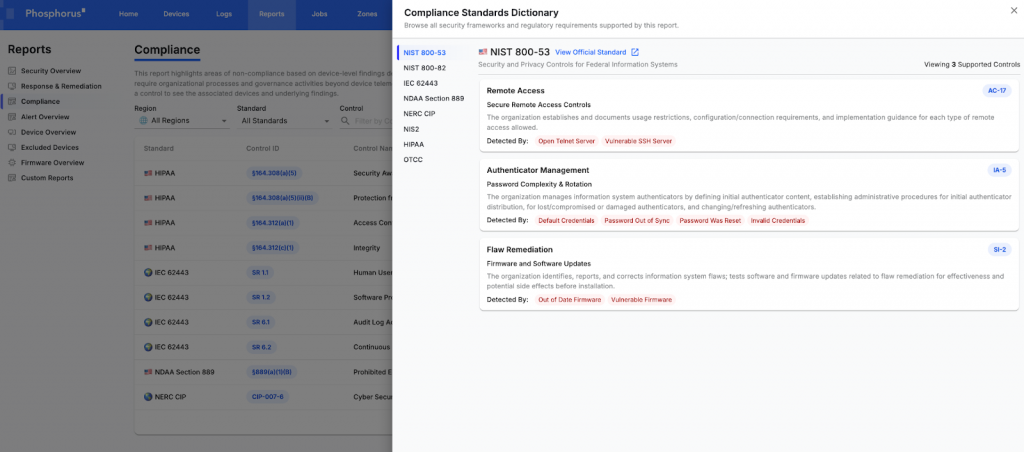

Introducing the Phosphorus xIoT Compliance Report
Phosphorus is introducing a new capability that changes how compliance works for connected devices. The Phosphorus xIoT Compliance Report shifts compliance from documentation and interpretation to demonstrated control.
Instead of asking whether policies exist or reports are up to date, compliance becomes an observable outcome of how devices are actually configured, accessed, and maintained. Proof is generated through action, not paperwork.
From Checklists to Control
Traditional compliance relies on checklists, attestations, and point-in-time evidence collection. That approach may satisfy documentation requirements, but it does little to demonstrate whether controls are actually operating.
With the Phosphorus xIoT Compliance Report, compliance is derived from real device state. Controls are proven through execution. Evidence is discovered from granular device details and directly tied to the condition of the environment.
This moves compliance from a reporting exercise to an operational function.
Why Compliance Breaks Down in xIoT Environments
In most organizations, compliance breaks down long before an audit begins.
Security teams identify device risk. Compliance teams translate findings into controls. Operations teams remediate devices using separate platforms. The result is a disconnected workflow where compliance status lags behind actual device state and audit evidence is assembled manually.
That disconnect is amplified in xIoT environments, where:
- Devices do not conform to IT-centric compliance tooling
- Regulatory frameworks overlap across regions and industries
- Remediation must occur at scale, often under audit pressure
The industry has built tools to document compliance and tools to manage devices. It has not built a system that unifies both. The result is compliance that reflects intent rather than control effectiveness.
The Phosphorus Difference: Visibility and Action
Phosphorus approaches compliance from the device outward, starting with visibility that is both accurate and actionable.
The Compliance Report is built on the premise that regulatory controls are enforced, or violated, by specific device-level conditions. Firmware versions, credential states, configurations, exposed services, and vendor attributes are the mechanisms through which compliance succeeds or fails.
Phosphorus actively interrogates devices to collect granular configuration and state data directly from the source. This includes authentication posture, firmware state, exposed services, and security- and operational-relevant configuration.
These concrete device attributes enable state-based control mapping, replacing inferred compliance with verifiable, system-generated evidence. Visibility alone is not enough. What matters is the ability to act on what you see.
Remediate. Get the Proof. Automatically.
Traditional compliance tools stop at identification. Phosphorus closes the loop.
The Compliance Report is integrated directly into the Phosphorus platform, enabling teams to remediate compliance gaps through controlled, auditable actions such as credential rotation, firmware management, configuration enforcement, and privileged access enrollment.
These actions function as preventive, detective, and corrective controls executed at the device layer. When remediation occurs, compliance status updates automatically. When device state changes, compliance reflects it immediately.
There is no downstream handoff, no parallel workflow, and no manual reconciliation. Fixing the problem becomes the proof.
Built for Regulated, Real-World Environments
The Phosphorus xIoT Compliance Report is designed for environments where regulation is complex and device diversity is the norm. It supports xIoT device-centric regulatory frameworks across government, critical infrastructure, healthcare, and global operations, including:
- NIST 800-53 and NIST 800-82
- IEC 62443
- NERC CIP
- HIPAA
- NDAA Section 889
- NIS2
- OTCC
Standards can be applied by region and operational boundary to reflect how environments actually operate, not how frameworks are written. This allows organizations to manage overlapping regulatory requirements without duplicative tooling or manual evidence collection.
The Payoff: Control You Can Prove
With this release, compliance becomes continuous, operational, and defensible.
Organizations gain current-state compliance grounded in observable device behavior rather than point-in-time snapshots. Remediation can be prioritized by regulatory impact instead of alert volume. Compliance enforcement extends beyond traditional IT into IoT, OT, and IoMT environments. Supply chain and vendor restrictions are validated against discovered devices, not assumed inventories.
The Phosphorus xIoT Compliance Report delivers an operational compliance layer where regulatory requirements are enforced through direct control of devices and proven through execution.
Proof beats paper, and control is no longer implied. It is enforced.
Want to see it and all the great functionality of the Phosphorus autonomous xIoT security and management platform?
Check out the solution brief: https://phosphorus.io/resources/compliance-solution-brief/
Schedule a free demo: https://phosphorus.io/request-a-demo/
Author
Phosphorus Cybersecurity
Phosphorus Cybersecurity® is the leading xTended Security of Things™ platform designed to find, fix, and monitor the rapidly growing and often unmonitored Things of the enterprise xIoT landscape.