

Phosphorus is an xIoT security and management platform that discovers, assesses, and actively remediates risk across connected devices, including IoT, OT, IoMT, and IIoT. It enables organizations to move beyond visibility by automating actions such as password rotation, firmware updates, certificate management, and configuration hardening at scale.
Phosphorus autonomous xIoT security and management platform
Secure and manage connected devices at machine scale; safely, automatically, continuously, with human oversight, not limitations.
Deploys at scale in minutes. No SPAN ports, TAPs, packet brokers, or proprietary hardware required.
Deploys at scale in minutes. No SPAN ports, TAPs, packet brokers, or proprietary hardware required.
The platform that puts you in control
Most xIoT (IoT, OT, IoMT, and IIoT) security tools stop at identifying devices and vulnerabilities, leaving remediation to overburdened security and operations teams. The Phosphorus Platform automates discovery and risk assessment, device hardening and remediation, as well as continuous monitoring and management for every connected device.

Discover & assess
Safely discover, classify, and assess all xIoT devices in minutes, with no expensive hardware, SPANs, TAPs, or packet brokers.

Harden & remediate
Automatically remediate xIoT device vulnerabilities, including credentials, firmware, certificates, & risky configurations.

Monitor & manage
Continuously monitor and manage all xIoT devices, while detecting and responding to device drift.
Modular flexibility
Select the platform capabilities your security and operations teams need to reduce xIoT risk and strengthen operational resilience across your organization. Add capabilities as your organization matures.
Discover and assess
Visibility across tens of thousands of connected devices with high-fidelity data on device attributes, vulnerabilities, misconfigurations, and policy compliance gaps.
xIoT
asset discovery
-
Discover and profile devices with extensive contextual detail across a wide range of device attributes.
Attributes includeDevice typeManufacturerModel/seriesIP addressActive protocolsFirmware versionOpen portsDevice-specific information
xIoT
vulnerability assessment
-
Identify, classify, and prioritize vulnerabilities across your xIoT estate to understand and mitigate risks before attackers can exploit them.
This includesDefault passwords in useFirmware availabilityCVEs with added context from CISA's Known Exploited Vulnerabilities (KEV) catalog and FIRST's Exploit Prediction Scoring System (EPSS)End-of-life devicesInsecure configurationsExpired or self-signed certificates
Prohibited device
detection and response
-
Discover and remotely disable devices banned by the U.S. Government (NDAA Section 889 – Chinese-manufactured).
This includesDevices manufactured by Huawei, Dahua, Hikvision, ZTE, and HyteraDevices with firmware that was OEMed from the above companies, regardless of device manufacture.
Harden & remediate
Don’t just find it. Fix it. Remediation tasks can be scheduled across thousands of devices within defined maintenance windows.
Password
management
-
Automated default and weak password remediation
-
Scheduled credential rotation
-
Granular policy enforcement
-
Embedded password vault
Firmware
management
-
Upgrade and downgrade firmware at scale
-
Automated firmware discovery & risk context (CVE, EPSS, KEV)
-
Safe upgrades and downgrades
Certificate
management
-
Manage and renew certificates at scale across diverse device sets
-
Identify devices operating with expired, self-signed, or improperly configured certificates
-
Automatically update them at scale (renew and install)
Configuration
management
-
Remotely disable unnecessary network services on a device, such as Telnet or FTP
-
Take custom device-specific actions
-
Configure devices remotely at scale
Monitor & manage
Centrally monitor and manage device configurations, security analytics, and ransomware resilience with backup and restoration.
Device state
monitoring
-
Continuously monitor xIoT estates to detect and alert on device drift and operational changes.
This includesOut-of-band password resetOut-of-band firmware upgrade or downgradeOut-of-band certificate changeDevice offlineDevice resetCustom device-specific alerts (PLC physical setting change, IP camera white balance change, power usage or temperature threshold exceeds limit, BMC authentication mechanism, Printer toner type (non-OEM alert), etc)
Device log
retrieval
-
Centralize log collection and analytics for detailed device-level security analysis, anomaly detection, triage, and forensics.
Retrieve device logs from multiple device types and manufacturers, includingAudit logsSystem events
Device
backups
-
Increase resilience against ransomware with device configuration backup and restoration
Coming Soon
Get up to speed
Start learning the basics and see what Phosphorus can make possible for your projects.
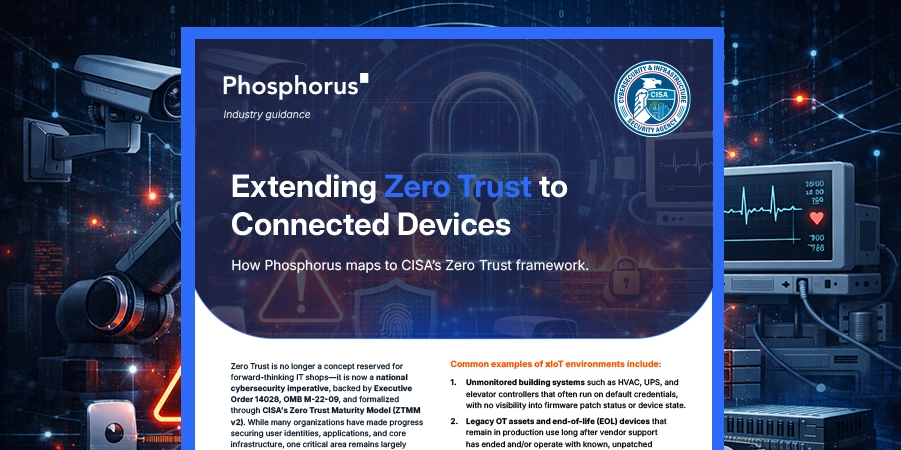
Phosphorus Maps Zero Trust Solution Brief
Learn how Phosphorus extends Zero Trust to xIoT devices by aligning with CISA’s framework to improve visibility, reduce risk, and secure unmanaged assets.
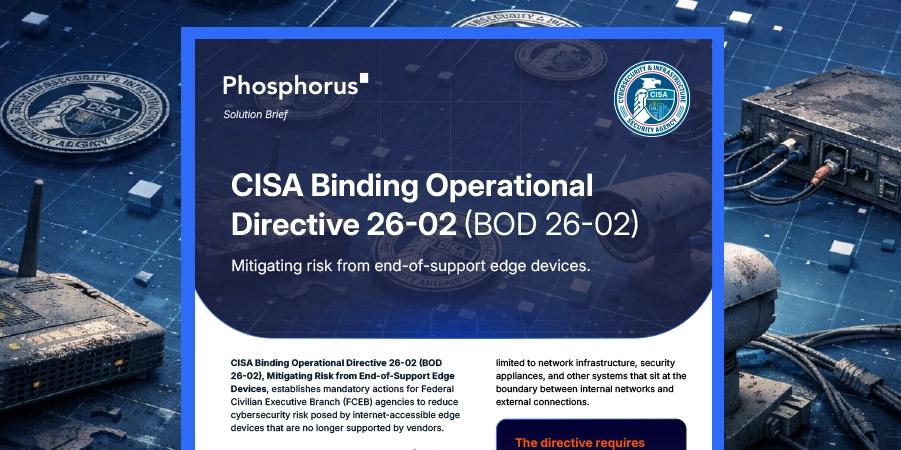
CISA Binding Operational Directive 26-02 Solution Brief
Learn how CISA’s Binding Operational Directive 26-02 helps federal and enterprise teams mitigate risks from unsupported edge devices and improve cybersecurity posture.
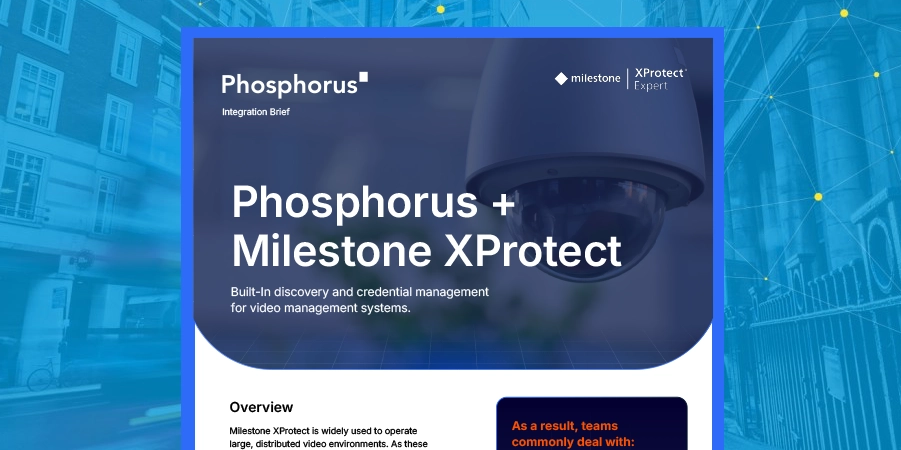
Phosphorus + Milestone XProtect Integration Brief
Discover how the Phosphorus-Milestone XProtect integration delivers unified security visibility and streamlined threat context across video management and xIoT environments.
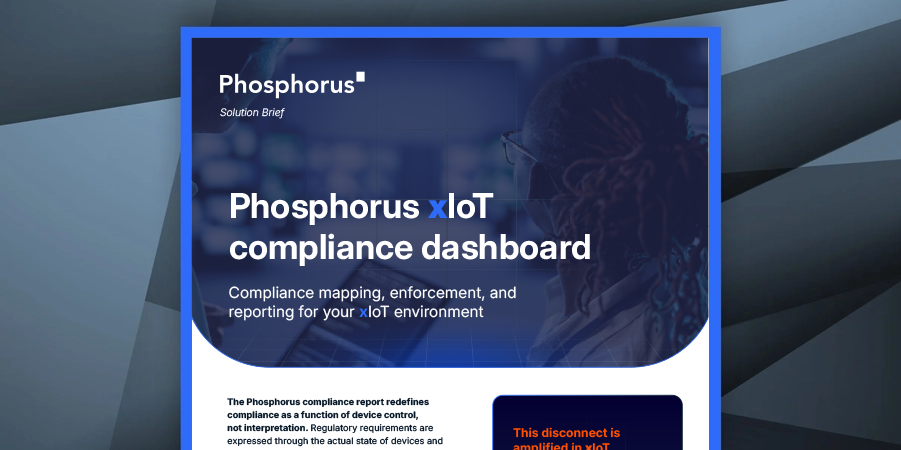
Phosphorus Compliance Solution Brief
Compliance mapping, enforcement, and reporting for your xIoT environment.
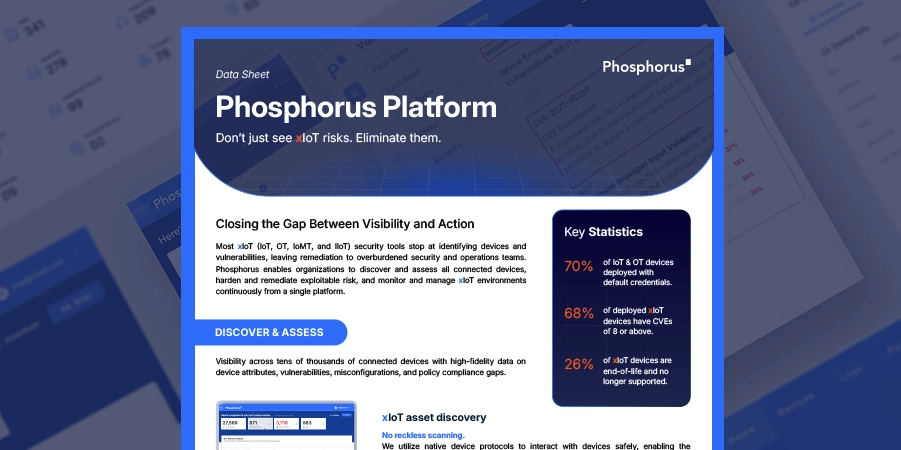
Platform Data Sheet
See how the Phosphorus Platform secures, manages, and monitors every connected device at scale.
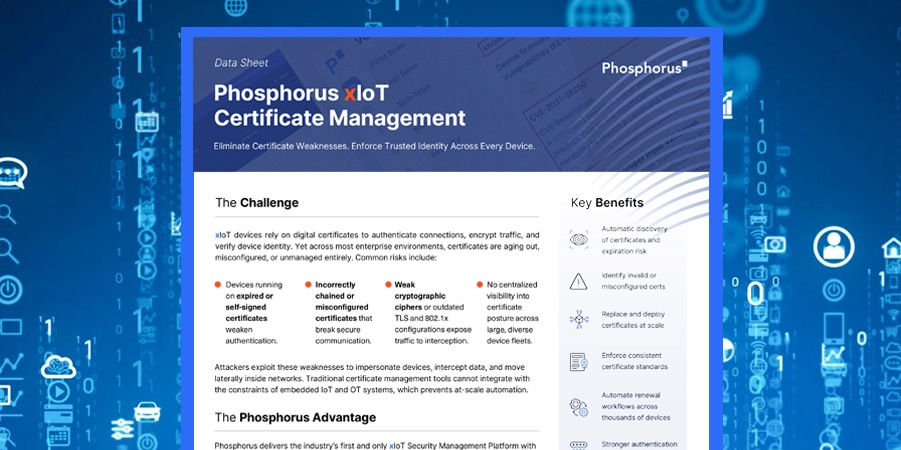
Certificate Management Data Sheet
Discover how Phosphorus Certificate Management keeps device certificates current, compliant, and secure.

Password Management Data Sheet
Discover how Phosphorus Password Management secures and enforces strong credentials across connected devices.
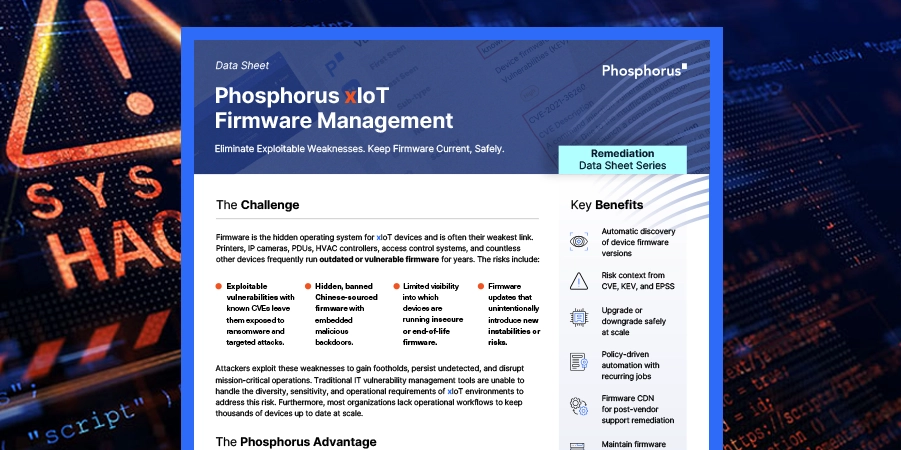
Firmware Management Data Sheet
See how Phosphorus Firmware Management automates firmware updates and hardens all connected devices at scale.
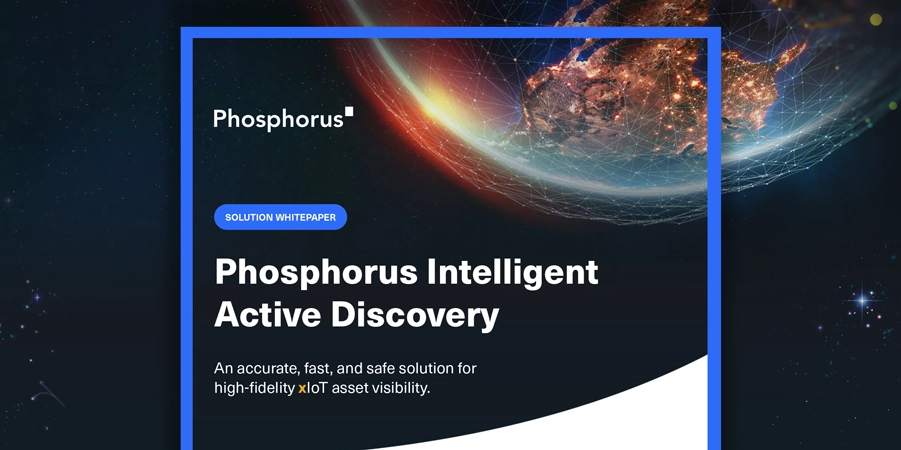
Intelligent Active Discovery White Paper
See how the Phosphorus outlines a fast, safe, and accurate approach to finding and classifying every IoT/OT/IoMT device in your environment.
Frequently asked questions
Phosphorus platform
No FAQs matched your search. Try a different keyword or topic.
Platform Overview
0
Phosphorus delivers full lifecycle xIoT security across three core pillars:
1. Discover & Assess
High-fidelity device inventory (15+ attributes per device)
Identification of:
• Default credentials
• Vulnerabilities (CVEs with KEV + EPSS context)
• End-of-life devices
• Misconfigurations
• Certificate risks
• Safe discovery using native protocols (no reckless scanning)
2. Harden & Remediate
• Automated password rotation at scale
• Firmware upgrades/downgrades
• Certificate lifecycle management
• Configuration hardening (disable services, enforce encryption)
• Compliance enforcement (e.g., NDAA banned devices)
3. Monitor & Manage
• Continuous device monitoring for drift
• Log collection and analysis
• Backup & restore for ransomware resilience (In Development)
• Device-level security analytics
👉 The key differentiator: Phosphorus doesn’t just find issues—it empowers you to fix them at scale.
Phosphorus is designed to integrate seamlessly into your existing security and IT ecosystem, extending the value of your current tools by adding high-fidelity xIoT visibility and automated remediation.
Rather than replacing existing investments, Phosphorus enriches, operationalizes, and automates them.
Identity & Privileged Access Management (PAM)
Integration Partners:
CyberArk, HashiCorp Vault, and other leading enterprise PAM platforms
Phosphorus integrates with all major Privileged Access Management (PAM) solutions to extend identity security into xIoT environments:
Automatically discovers devices and associated credentials
Syncs credentials into enterprise vaults (e.g., CyberArk, HashiCorp Vault)
Enables bi-directional credential rotation across devices and vaults
Supports Just-in-Time (JIT) access and Zero Trust models for machine identities
Automates credential lifecycle management across IoT, OT, IoMT, and IIoT devices
👉 Phosphorus acts as the execution layer for PAM in xIoT, enabling credential enforcement, rotation, and validation directly on devices—something traditional PAM tools cannot do alone.
👉 Example: With CyberArk, Phosphorus enables centralized credential governance, Zero Standing Privilege (ZSP), and automated rotation across thousands of devices.
Vulnerability Management
Integration Partners:
Qualys, Armis
Phosphorus enhances vulnerability management platforms by providing deep device-level context and remediation capabilities:
Enriches vulnerability findings with real device intelligence
Correlates vulnerabilities with firmware, configuration, and credential state
Enables automated remediation directly from vulnerability insights
👉 Phosphorus closes the gap between identification and action, where traditional tools stop.
Asset Inventory & Cyber Asset Management
Integration Partners:
Axonius, Sevco
Phosphorus integrates with asset management platforms to provide a complete, unified asset inventory across IT and xIoT:
Feeds high-fidelity device data into asset platforms
Identifies unknown and unmanaged devices
Continuously updates asset records with real-time device posture
Enables cross-domain correlation (IT + OT + IoT)
👉 This ensures asset systems are no longer dependent on incomplete or inferred data.
CMDB & IT Service Management (ITSM)
Integration Partners:
ServiceNow
Phosphorus integrates with ITSM platforms to operationalize xIoT security within existing workflows:
Automatically populates and updates the CMDB with xIoT assets
Syncs vulnerabilities into ServiceNow Vulnerability Response (VR)
Triggers tickets and workflows for remediation
Enables closed-loop remediation tracking
👉 This bridges security and operations teams with real-time device intelligence.
SIEM & Security Operations
Integration Partners:
Microsoft Sentinel, Splunk, Cribl
Phosphorus integrates with SIEM platforms to provide centralized visibility and detection for xIoT risk:
Streams telemetry, alerts, and device context into the SIEM
Enables correlation with broader security events
Supports automated incident response playbooks
Enhances SOC visibility with xIoT-specific intelligence
👉 This allows SOC teams to treat xIoT risks as part of standard security operations.
Network Security & Enforcement
Integration Partners:
Check Point, Forescout
Phosphorus integrates with network security platforms to combine visibility with enforcement:
– Enriches network tools with accurate device intelligence
– Enables policy enforcement based on real device posture
– Supports segmentation and containment workflows
– Complements passive monitoring with active validation and remediation
👉 Phosphorus adds the missing layer: the ability to fix issues, not just detect them.
Physical Security & IoT Ecosystem
Integration Partners:
Milestone Systems (XProtect)
Phosphorus integrates with physical security platforms to provide:
Visibility into connected physical security devices (e.g., cameras, access systems)
Device-level risk assessment for physical security infrastructure
Integration of physical systems into broader cybersecurity workflows
Cloud, API & Extensibility
Integration Partners:
AWS, Microsoft Azure, Google Cloud Platform (GCP)
Phosphorus supports modern, API-driven environments:
Full REST API access for automation and orchestration
Integration into cloud-native workflows and pipelines
Support for custom integrations and extensibility
Enables dynamic scanning and automated security actions
How Phosphorus Fits Into Your Stack
Across all integrations, Phosphorus serves as:
System of record for xIoT devices (accurate, real-time data)
Enrichment layer for existing tools
Execution engine for automated remediation
👉 In practice:
Your existing tools detect and prioritize risk
Phosphorus validates, enriches, and fixes it at scale
Phosphorus is designed for fast, flexible deployment:
Deployment Options
On-premises (virtual appliance)
Cloud (AWS, Azure, GCP)
Hybrid environments
Key Deployment Characteristics
No agents required
No SPAN ports or TAPs required
No hardware dependencies
Works in segmented and air-gapped networks
Architecture Overview
Can run on a single appliance
Optional zoneWorker enables:
Distributed scanning
Support for segmented networks (DMZ, airgap)
Reduced network complexity
Initial deployment: Hours
First discovery results: Minutes
Full environment visibility: Typically same day
Phosphorus delivers immediate time-to-value compared to legacy tools that take months or years to implement.
No major changes are required.
Requirements:
Outbound HTTPS (TCP 443)
Access to device communication ports for discovery
Optional siteManager for segmented networks
Phosphorus avoids:
Network re-architecture
Traffic mirroring (SPAN/TAP)
Inline deployments
Yes.
Phosphorus is designed specifically for cyber-physical systems (CPS) environments:
• Uses native device protocols instead of aggressive scanning
• Dynamically adjusts probe behavior via IAD
• Minimizes network impact and device disruption
👉 The platform’s discovery engine automatically calibrates scanning behavior to ensure safety across industries like healthcare, manufacturing, and critical infrastructure.
Phosphorus eliminates manual work by:
• Automating remediation tasks
• Centralizing device management
• Reducing reliance on multiple tools
• Enabling security and operations teams to scale
👉 Result: Less manual effort, faster risk reduction, and improved security posture without increasing FTE count.
Visit phosphorus.io to:
• Request a demo
• See the platform in action
• Speak directly with an expert
Phosphorus can discover and classify devices in minutes, not months, and does not require agents, hardware, or network changes. Organizations gain immediate visibility and can begin remediation almost immediately after deployment.
No. Phosphorus is agentless and does not require SPAN ports, taps, or additional hardware. It can be deployed on-premises, in the cloud, or in hybrid environments with minimal setup.
Organizations using Phosphorus typically achieve:
• Full visibility into all connected devices
• Reduction in attack surface through automated remediation
• Elimination of default credentials and insecure configurations
• Faster response to vulnerabilities and compliance requirements
• Lower operational burden on security teams
xIoT Basics
0
The Genus-Species Model
One of the early technical challenges was scale.
xIoT environments include:
• Millions of device models
• Thousands of manufacturers
• Constantly evolving firmware and configurations
However, Phosphorus discovered that devices operate on a Genus-Species model:
• Devices are identified at both the manufacturer family level (genus) and the specific model/variant level (species)
• This enables rapid, accurate classification across over a million device models
• New device types can be added quickly without rebuilding detection logic
• Example: for 10,000 printer models (species) under a major manufacturer, they only operated on five different types of software-on-a-chip (genus)
👉 This approach allows Phosphorus to scale device coverage exponentially, while maintaining high-fidelity accuracy required for remediation—not just visibility.
Discovery
0
Phosphorus supports a wide range of connected devices, including:
• IoT devices like cameras, printers, and badge readers
• OT and industrial systems such as PLCs and controllers
• IoMT devices like infusion pumps and patient monitors
• Network infrastructure and building management systems
This breadth enables a complete view of the xIoT attack surface across industries.
Phosphorus uses its patented Intelligent Active Discovery, which interacts with devices through their native protocols instead of relying on network traffic analysis. This approach is far superior and delivers accurate device identification and risk assessment without disrupting operations or overwhelming sensitive systems.
Phosphorus currently delivers 96% precision for customers on average.
It delivers high-fidelity, device-level accuracy because it:
• Communicates directly with devices
• Collects real attributes (not inferred data)
• Profiles devices using firmware, services, and protocols
This avoids the inaccuracies common in:
• MAC address lookups
• Passive traffic analysis
Risk Remediation
0
Phosphorus provides deep risk visibility, including:
• Default or weak credentials
• Outdated or vulnerable firmware with CVE, KEV, and EPSS context
• Expired or self-signed certificates
• Insecure configurations and open ports
• End-of-life or unsupported devices
Banned or high-risk devices, including those restricted by NDAA Section 889
Phosphorus identifies and remediates:
• Default or reused passwords
• Vulnerable or outdated firmware
• Expired or misconfigured certificates
• Insecure configurations
• End-of-life devices
• Non-compliant or banned devices
• Known exploitable vulnerabilities (KEV-based prioritization)
Yes—this is a core differentiator.
Phosphorus enables:
• Bulk remediation across thousands of devices
• Scheduled changes within maintenance windows
• Policy-based automation
Examples:
• Rotate passwords across all devices
• Upgrade firmware fleet-wide
Yes. Phosphorus enables direct, automated remediation across xIoT devices, including:
• Password rotation and credential enforcement
• Firmware upgrades and downgrades
• Certificate replacement and renewal
•Configuration hardening, such as disabling Telnet or FTP
These actions can be executed at scale across thousands of devices with minimal operational impact.
Phosphorus automatically detects and replaces default or weak credentials across devices. It enforces password policies, schedules rotations, and securely stores credentials in an embedded vault, reducing one of the most common attack vectors in xIoT environments.
Phosphorus continuously identifies firmware versions across devices, enriches them with CVE, KEV, and EPSS intelligence, and automates patching workflows. It supports both upgrades and safe downgrades to maintain stability while eliminating exploitable vulnerabilities.
Phosphorus reduces risk by combining three core capabilities in a single platform:
1. Discover and assess every device
2. Harden and remediate vulnerabilities automatically
3. Continuously monitor for drift and emerging risk
This approach ensures that risks are not only identified but actively eliminated.
Compliance & Zero Trust
0
Phosphorus extends Zero Trust principles to connected devices by ensuring every device is identified, authenticated, continuously assessed for risk, and actively managed. It aligns directly with CISA’s Zero Trust Maturity Model across identity, device, network, and data pillars.
Phosphorus enables organizations to meet cybersecurity and regulatory requirements by combining complete asset visibility, risk assessment, automated remediation, and compliance reporting for xIoT environments.
Core Compliance Capabilities
Comprehensive Asset Inventory
• Maintain a continuously updated inventory of all network-connected IoT, OT, IoMT, and IIoT devices.
Risk Identification & Prioritization
• Detect vulnerabilities, default credentials, insecure configurations, expired certificates, and end-of-life devices—prioritized with KEV and EPSS context.
Automated Remediation
• Execute remediation actions at scale, including password rotation, firmware updates, certificate management, and configuration hardening.
Continuous Monitoring
• Track device state, configuration drift, and emerging risks across the environment.
Compliance Reporting
Generate audit-ready reports that demonstrate:
• Device inventory and coverage
• Identified risks and remediation status
• Policy compliance and security posture over time
This enables security teams to provide clear evidence of control, mitigation, and continuous risk management to auditors and regulators.
Phosphorus supports compliance initiatives across regulated industries, including:
33 CFR Part 101 (U.S. Coast Guard – Maritime Security, Subpart F)
• Helps covered entities maintain visibility and control of cyber risks impacting marine transportation systems through device inventory, risk detection, and ongoing monitoring.
CISA Binding Operational Directive (BOD) 26-02
• Enables federal civilian agencies to identify all network-connected devices, detect end-of-life or vulnerable assets, and take action to remove or mitigate risk.
NDAA Section 889
• Identifies and enables response to prohibited or banned devices (e.g., certain Chinese-manufactured equipment), supporting compliance with federal procurement and security requirements.
Yes. Phosphorus identifies devices from restricted manufacturers, including those disguised through OEMs, white-labeling, and even unlabeled devices, and enables organizations to isolate or remediate them. This supports compliance with regulations such as NDAA Section 889.
Are you ready to see
Phosphorus in action?
Request a demo to learn how we can help you eliminate the xIoT security gap with the only IoT, OT, and IoMT discovery and remediation platform.